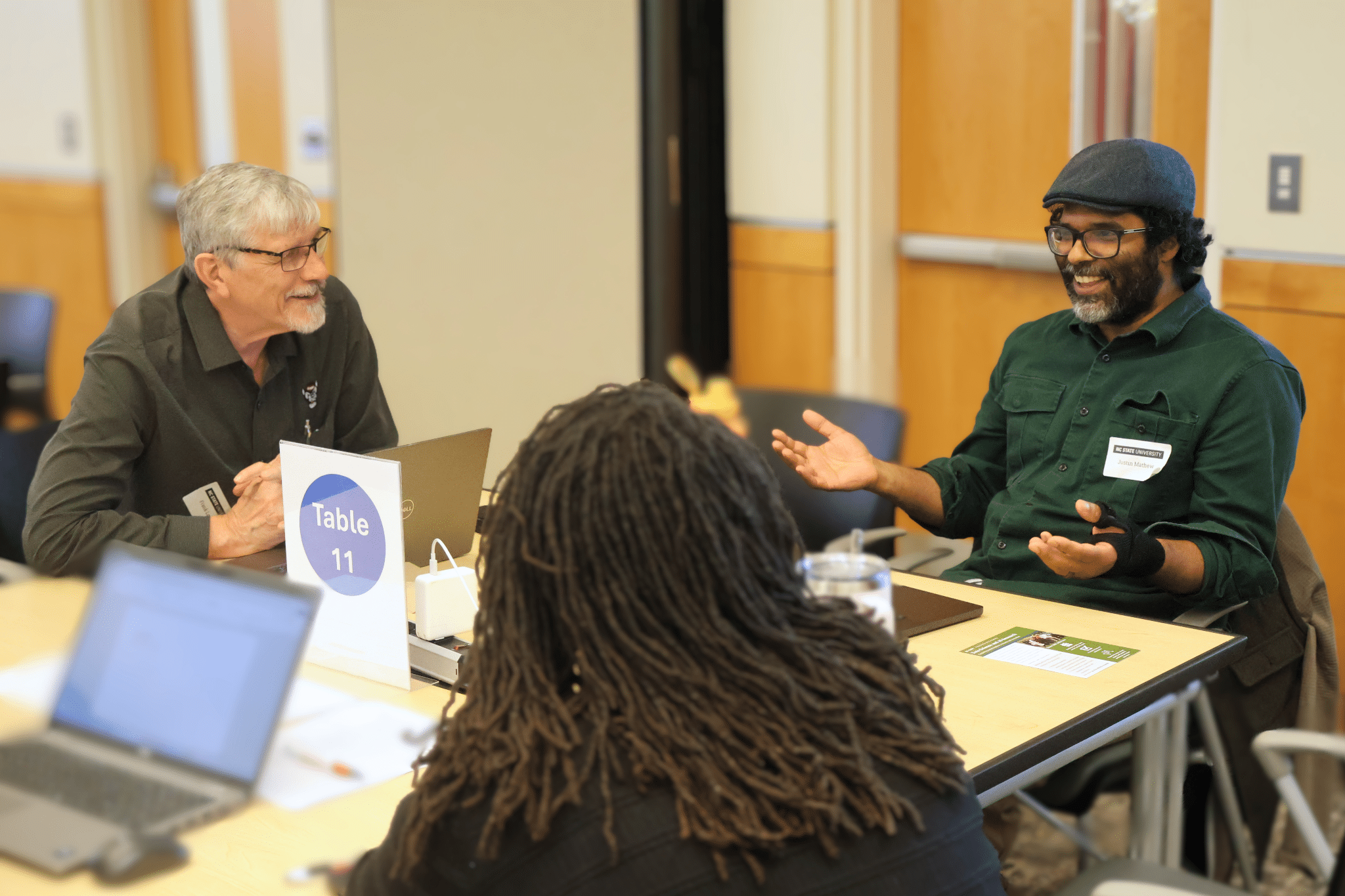
NC State Students Present Research at UChicago Data Science Symposium
NC State students Sonia Pereira and Nicole Page spent the summer in Chicago with the Data Science for Social Impact program, presenting research at the national Data Science Symposium. Their projects reflect how NC State students turn data science and AI skills into real-world impact.
Since Spring 2022, the Data Science and AI Academy (DSA) has partnered with the University of Chicago’s Data Science Institute and other schools around the U.S. to give NC State undergraduates a high-impact summer research opportunity through the Data Science for Social Impact Summer Experience (DSSI). DSSI equips students to frame questions, test ideas and express their findings as emerging researchers. Students move from an intensive technical bootcamp to collaborative projects with social impact to presenting their results at the Data Science Institute’s Summer Research Symposium in Chicago.
Over the past four summers, the DSA has funded a total of eight NC State undergraduates to join DSSI. In 2025, Park Scholar and Boren Scholar Sonia Pereira (International Studies, German Studies) and DSA Course Collaboration Leader, Nicole Page (Economics, Data Science, Psychology), represented NC State. Their summer in Chicago highlights how quickly students can grow when high expectations are paired with strong mentorship.
David Uminsky, Executive Director of the Institute, said the program is designed to create that transformation. “The goal is not just to give students research tasks, but to train them to think and speak like researchers. By the end of the summer, they are presenting complex work with clarity, and that’s exactly the impact we want to see.”
A demanding beginning
The first stage of DSSI is two weeks of technical training. Students spend full days moving from programming to machine learning and natural language processing while also engaging in conversations about ethics and applications. The schedule is fast by design, giving participants with varied backgrounds a common foundation for research.
Program administrator Molly Long added that the structure balances rigor with support. “Expectations are high, but we build in check-ins and professional development so students don’t feel lost,” they said. “Students come away with technical skills and also the confidence to ask questions, make mistakes and keep moving forward.”
Sonia Pereira: Commercial Debt Tracker

Pereira worked on the Commercial Debt Tracker in the Policy, Privacy and Advocacy track. Her team analyzed financial data to make lending practices more transparent and to identify patterns often hidden from view.
For Pereira, the challenge was as much about process as results. “We had to document every assumption and decision,” she said. “That made it easier to explain our results and think about what the next team could build on.”
She also credited the mentorship built into the program. “Even though the workload was intense, I always felt supported,” Pereira said. “Our mentors guided us, but they also gave us space to solve problems ourselves. That balance made me more confident about pursuing future research opportunities.”
Nicole Page: Palm Oil Projects Topic Classifier

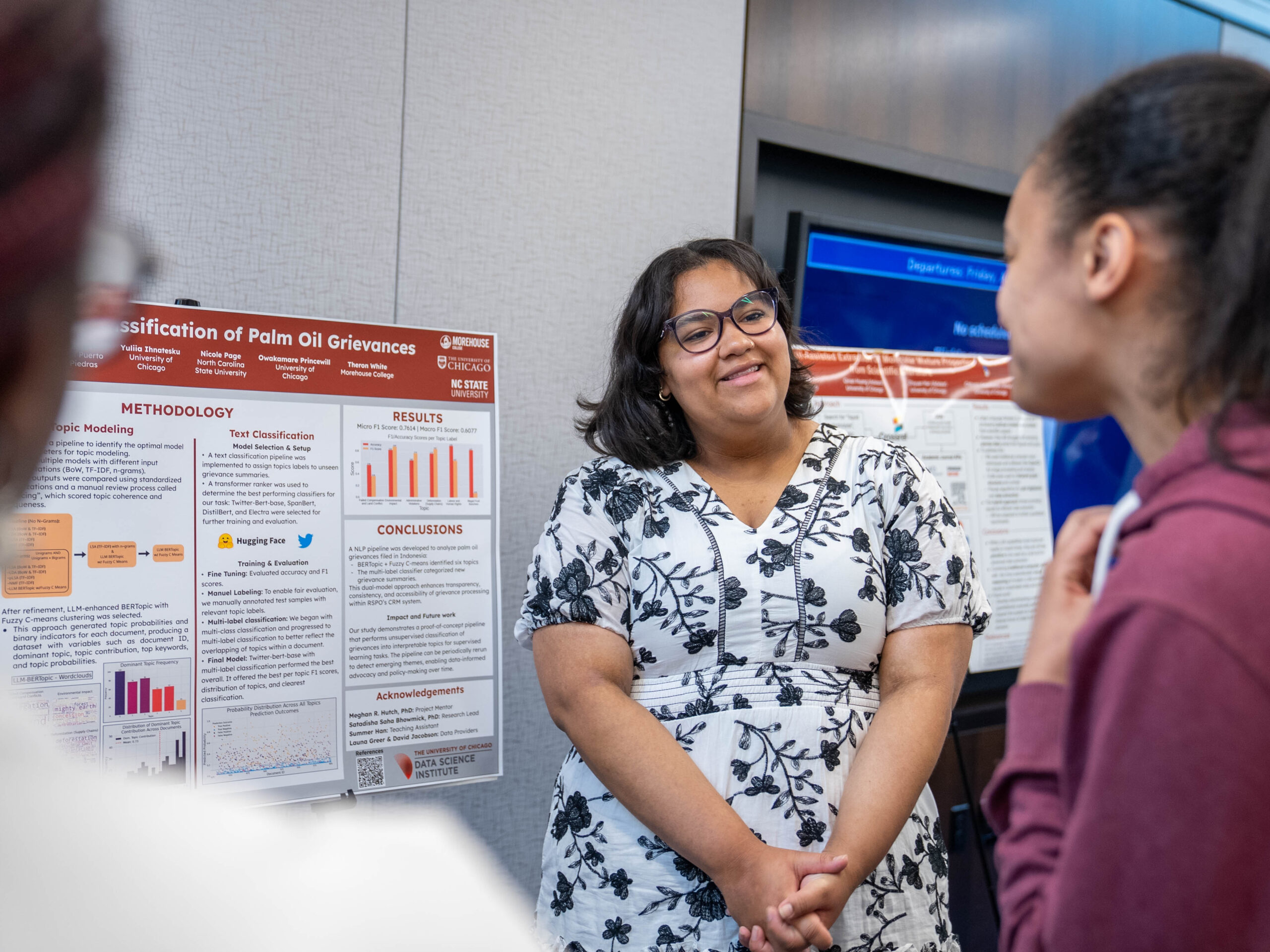
Page joined the Climate and Environment track on the Palm Oil Projects Topic Classifier, working with peers from U.S. and Puerto Rico-based institutions. The project combined topic modeling and text classification to categorize global palm oil initiatives, linking technical methods to sustainability research.
“Our project ended up being a two-part challenge,” Page said. “We had to do topic modeling first because the data didn’t come with clear categories, and then we built the classifier. It was complex, but I’m glad we got to see the problem in two different ways.”
The process reshaped how she sees data. “I used to see data as black and white,” she said. “Now I understand it can also be probabilities and nuances, especially with text. That completely changed how I see research.”
Growth beyond coding

DSSI emphasizes communication alongside technical skill. Students introduce speakers, give lightning talks and learn how to present findings to audiences outside their field. The goal is to make research legible, defensible and relevant.
Amanda Brown, Program Developer and Manager from the University of Texas at San Antonio, described this as essential. “Storytelling is everything. You can be doing highly technical work, but if you can’t explain it to people outside your field, it won’t be as impactful,” she said.
Peers also reflected on the shift. Tracy Nguyen of Truman College said that presenting her research through the summer pushed her to grow as a speaker. Theron White, a political science student from Morehouse College, noted that learning to ask better questions will shape his path in any career.
Satadisha Saha Bhowmick, the program’s research lead and a preceptor at the Data Science Institute, said this growth is what makes the program distinctive. “Students are not only learning technical skills,” she said. “They’re practicing teamwork, resilience and the ability to communicate under questioning. Those are skills they will use anywhere.
Symposium as capstone

The Symposium is the final triumph of the program. Students present in themed sessions, respond to questions from faculty and peers and stand beside posters where visitors stop, listen and engage. For many, it is the first time they have spoken about research in such a professional setting.
The format signals that the work is not just a class exercise. Projects are designed to continue, refined by future cohorts or expanded by the same students. Each presentation adds to an ongoing pipeline of research with impact beyond the summer.
Why NC State invests
For the DSA, the value of the partnership is clear. Students return from DSSI with sharpened technical skills, the ability to present research in a public forum and the confidence that comes from being part of a national network.
Rachel Levy, DSA Executive Director, said the experience aligns with NC State’s mission. “We want NC State students to see themselves as researchers and leaders,” she said. “Programs like DSSI show them that they belong on these global stages and that their skills can create real impact.”

Pereira and Page’s summer in Chicago reflects the strength of the partnership. Their projects demonstrate how data science can serve pressing challenges, and their growth over eight weeks shows why DSSI and NC State’s support matters. The symposium was the culmination of their journey, but it is only one step in preparing them for the work ahead.
Looking forward, DSA will continue to invest in opportunities like DSSI that push students beyond the classroom. By pairing high expectations with strong mentorship, NC State ensures that its undergraduates don’t just participate in data science; they help shape its future. Pereira and Page now join a growing network of DSSI alumni who carry forward both the skills and the confidence to contribute to meaningful change in research, industry and society.