Data Science and AI Education Share Fair Highlights Student Practice Across Disciplines
At the third annual Data Science and AI Education Share Fair, students from across majors shared projects developed through Data Science and AI Academy courses, examining how real data, thoughtful analysis and interdisciplinary perspectives shape learning in practice.

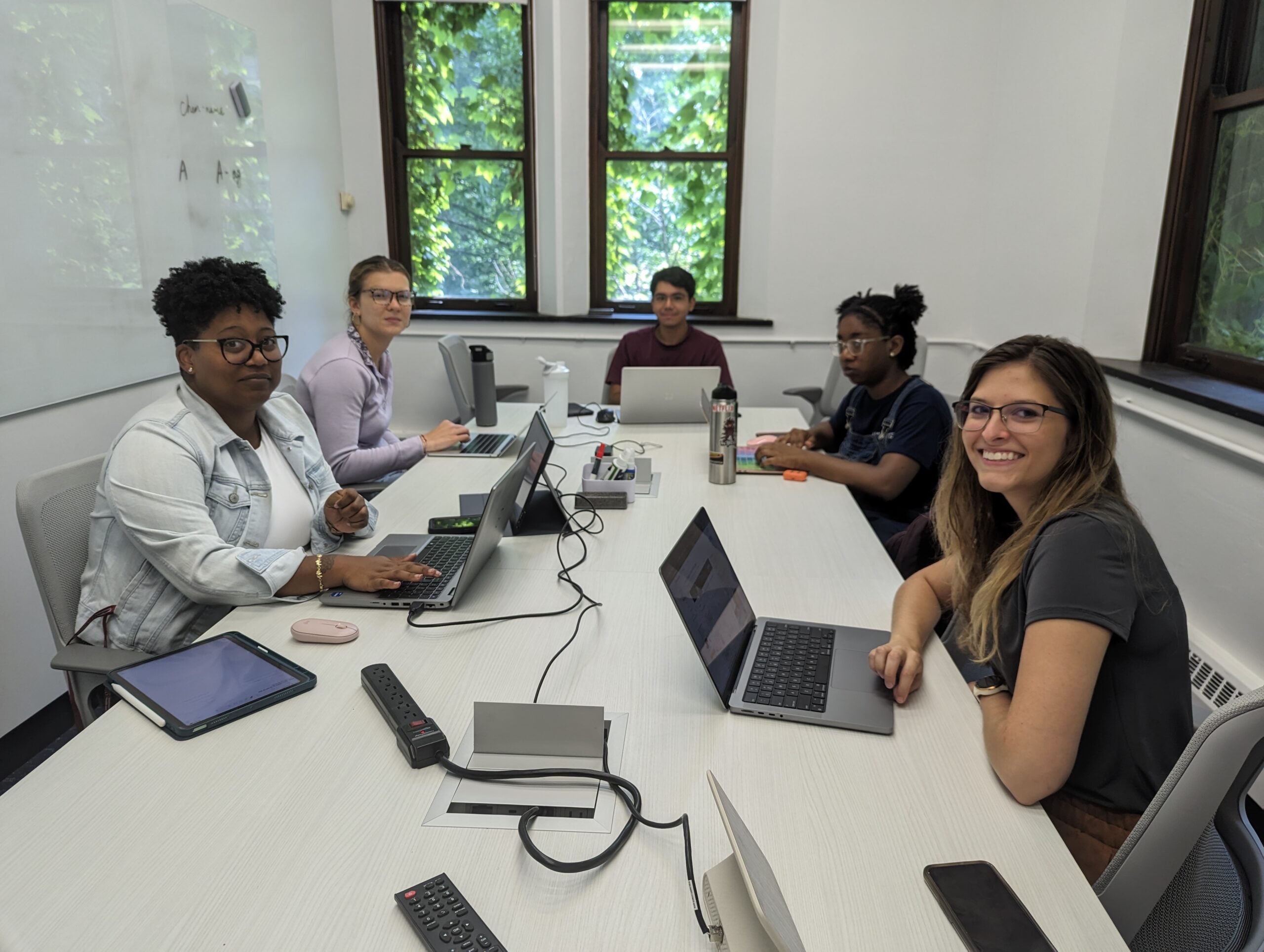
On January 30, the NC State Data Science and AI Academy (DSA) hosted the third annual Data Science and AI Education Share Fair at the NC State Libraries’ Teaching and Visualization Lab, with support from two National Science Foundation grants that support the DSA’s Postdoctoral Fellowship program and research on Improving Undergraduate STEM Education. Organized by DSA postdoctoral researchers Kelsey Virginia Dufresne, Tom R. Leppard and Jeanne McClure, the event brought together students, faculty and staff to explore how students are using data science and AI in coursework across disciplines. The conference focused on how DSA’s All-Campus Data Science and AI Project -based teaching and learning (ADAPT) model is expressed in different student projects and learning experiences.
The ADAPT model is a teaching and learning framework that supports project-based learning through real-world data science workflows and authentic applications tied to students’ fields of interest and workforce trends. It is built around three core components: Project-Based Learning, 10 Common Learning Elements and Workforce Preparedness, and emphasizes student agency to support interdisciplinary academic and career development.
Rachel Levy, executive director of DSA, opened the program by asking attendees to think about an educational experience that stayed with them, whether it was difficult, affirming or unexpected. She spoke about how those moments shape confidence and direction over time.
“If you can learn collaboratively with others, you can achieve just about everything,”
– Rachel Levy

As students and audience members described their experiences in DSA courses, common themes emerged: hands-on learning, numbers, spreadsheets, decision-making, storytelling and the power of data to make informed decisions. Sunghwan Byun, DSA faculty director of education research and assistant professor in the Department of STEM Education, guided the discussion, grounding it in how students encounter data science and AI through coursework designed using the ADAPT model.
Students then shared projects that addressed economic, environmental, technical and social questions, using a range of tools and approaches.
Soumya Pannala, a statistics major with a concentration in data science and a minor in business administration, examined cost-of-living differences across countries using R. Her analysis connected affordability to business ownership and infrastructure and identified transportation systems as a key factor.
Tony Taraboi, Omar Karime and Usman Malik, all business analytics majors, analyzed vehicle collision data in Manhattan, focusing on pedestrian safety and community development. Karime spoke about the responsibility that comes with working on data tied to real people. Taraboi described how the project changed the way they noticed data in everyday environments and considered how analysis can inform decisions that affect communities.
Vy Tran, an electrical engineering major, examined coffee consumption from a student perspective using Python and R. She described how the structure of the course supported learning and reduced anxiety. “The course did not have tests or quizzes, which lowered my anxiety and allowed me to retain information better,” she said.

Zoya Das, a genetics major, presented research on perceptions of AI at NC State, including concerns related to art, environmental impact, emissions, water use, labor and agriculture. “This course helped me learn how data and data science have real-world impact,” Das said. She also spoke about working with qualitative data and how that experience reshaped her understanding of what data can be. “This course taught me that data can look like anything,” she said.
As the presentations continued, questions shifted from results to practice. How do assumptions shape analysis? What happens when someone challenges the way you frame a problem?
Chloe Israel, a computer science major, presented research on environmental factors contributing to severe traffic accidents. This topic felt personally important due to her sister’s injury in a traffic accident. Her analysis showed that the most severe accidents often involved pedestrians and fixed objects. Israel described the discipline required to avoid letting the desire to discover something new interfere with how data is processed. During class discussion, a peer questioned whether weather was a meaningful predictor of accidents, noting that most days are sunny and clear. That exchange led Israel to revisit her approach and refine the analysis, resulting in findings she viewed as more accurate and more useful when people’s safety is involved.
Rabi Elabor and Isa Elabor traveled from Florida A&M University to participate in person and presented projects focused on environmental systems and heavy metal bioremediation. Isa raised questions about how research beginning in a classroom can extend beyond academic settings.

Jackson Tam, an applied mathematics major, presented a case study on blind juggling that required him to create his own dataset. He described how building data from scratch clarified the challenges of dataset design and reinforced the importance of persistence. He also spoke about his interest in data storytelling and visualization.
A question from Michael Renne from the North Carolina Department of Public Instruction prompted discussion about bias and interpretation. Students spoke about the value of outside perspectives in testing assumptions and improving accuracy.
When asked to reflect on their experiences in DSA courses, students pointed to choice, curiosity and the ability to keep building skills over time. Those themes also reflect the growing demand for DSA’s course offerings and global interest in the ADAPT model. DSA shares the ADAPT model and its application with academic audiences through partnerships with community colleges and universities across NC, as well as internationally at Nagoya University, Seoul National University, and National Taiwan University of Science and Technology.
Those interested in bringing project-based data science and AI into classrooms, programs or training environments can explore the ADAPT model on the DSA website or contact the DSA team at [email protected]. Students can get involved by enrolling in a DSA course or attending a DSA event. Follow DSA on LinkedIn and Instagram to stay up to date.
Acknowledgement: This material is based upon work supported by the National Science Foundation under Grant No. 2222148 STEM Ed PRF: Mentoring a Diverse Cohort of Postdoctoral Scholars in Data Science Education Research and Grant No. 2313644: Creating Data Science Learning Pathways Through Project-Based Learning
Disclaimer: Any opinions, findings and conclusions, or recommendations expressed in this material are those of the author(s) and do not necessarily reflect the views of the National Science Foundation.
- Categories: