AI Hot Topics: Beyond Prediction
Industry experts explored synthetic data, agentic intelligence and quantum computing—and what these technologies signal for the next phase of artificial intelligence.

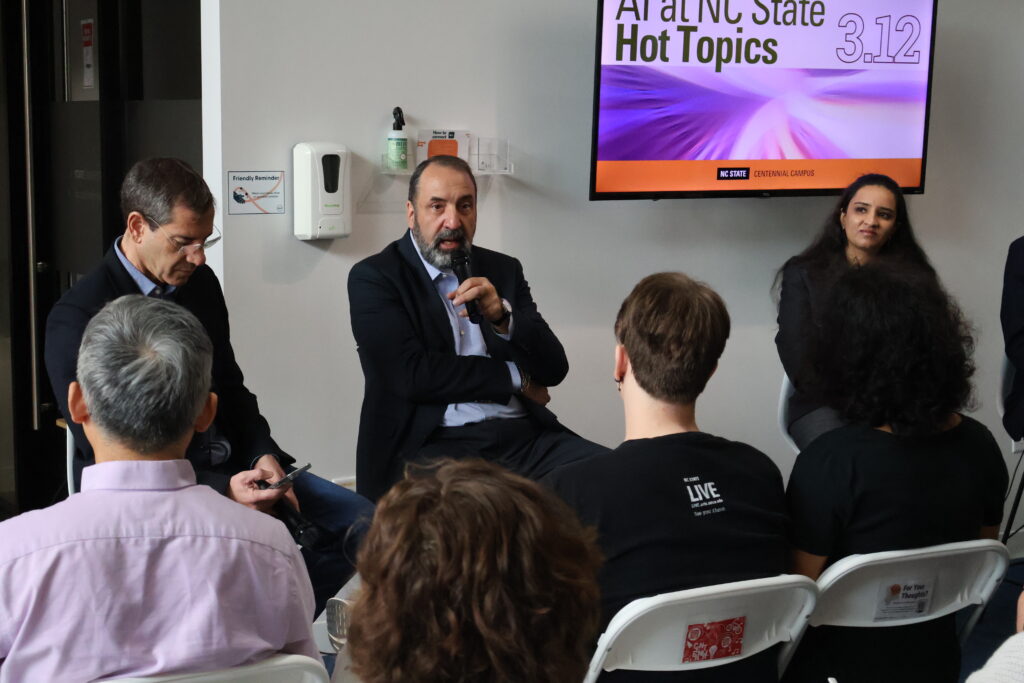
Artificial intelligence (AI) is moving beyond prediction. At a recent AI Hot Topics forum, the NC State Data Science and AI Academy brought together industry leaders, faculty, staff and students to examine how synthetic data, agentic intelligence and quantum computing are expanding what AI systems can do.
Held at Raleigh Founded on NC State’s Centennial Campus, the session focused on how these technologies are moving from research concepts into real-world systems. Discussion explored emerging approaches to training AI models, coordinating complex processes and accelerating computation, developments that are reshaping how AI is designed and applied across industries.

One focus of the discussion was agentic intelligence, an emerging approach in which AI systems coordinate multiple tools or models to complete tasks. Rather than simply producing predictions, agentic systems can monitor environments, make decisions and initiate actions within defined parameters.
“[Agentic intelligence] helps companies make decisions faster and safer,” said Carlos Pinheiro, distinguished data scientist at SAS.
Udo Sglavo, vice president of Applied AI and Modeling R&D at SAS, emphasized the broader potential of these systems as they continue to develop.
“Better performance, better sensitivity to human needs, better context awareness… all of those are good prospects for agentic computing.”
While advances in system design are expanding what AI can do, changes in how models are trained are equally important. A major theme of the discussion was the growing role of synthetic data: artificial datasets designed to simulate real-world conditions. Many AI systems struggle with rare events because the data needed to train them simply does not exist in large enough quantities. Fraud detection illustrates the challenge. If a company had enough real fraud data to train a model, it would likely already have a serious fraud problem.
Synthetic data allows researchers and companies to generate simulated datasets that replicate these rare scenarios, enabling models to learn from situations that may be difficult, sensitive or impossible to capture at scale.
“Synthetic data gives you grounds to think about how your integrations line up, and I think that’s exceedingly valuable,” said Sglavo.
The session was moderated by Carlos Pinheiro of SAS and featured speakers Udo Sglavo and Hardi Desai of SAS alongside Munindar Singh, professor in the Department of Computer Science at NC State. Together, the panel brought perspectives from industry and academia to a conversation focused on how advances in data, system design and computing power are reshaping AI.
Beyond systems and data, the discussion also explored the next shift in computing power. Panelists described advances in computing power as a progression, from CPUs to GPUs, and now the emerging potential of quantum computing.
Quantum systems could dramatically accelerate certain calculations, allowing researchers to evaluate possibilities far faster than traditional computing architectures. This capability could open new opportunities in fields that rely on complex optimization and modeling.

Examples from industry illustrated how these developments are already influencing research and product development. Panelists highlighted how companies such as Procter & Gamble use advanced modeling systems to analyze everyday household challenges and explore new product solutions, from cleaning formulations to materials testing.
Audience questions broadened the conversation to workforce preparation and lifelong learning. Participants asked how students and early-career professionals can stay current as AI technologies evolve rapidly.
Munindar Singh encouraged students and professionals to remain proactive about learning new tools and technologies.
“Be curious. If you’re waiting for your manager to tell you to learn [a new technology], it’s too late.”
Panelists emphasized that while AI tools are becoming increasingly powerful, human expertise remains essential. Developing reliable systems requires careful training, thoughtful oversight and the ability to critically evaluate outputs, skills that will remain central as AI capabilities continue to grow.
As AI moves beyond prediction toward systems that simulate scenarios, coordinate actions and accelerate discovery, conversations like AI Hot Topics create space for researchers, students and industry leaders to examine what these changes mean in practice. For more information about AI Hot Topics and upcoming sessions, visit the DSA website at go.ncsu.edu/dsa.